
Which Charities Does La Française
des Jeux Support?
FDJ contributes billions to French society every year. Here is a complete overview of where the money goes — from sports federations and public health to cultural causes and veteran support.
📅 Updated April 2026 · ✅ Based on official FDJ public reporting
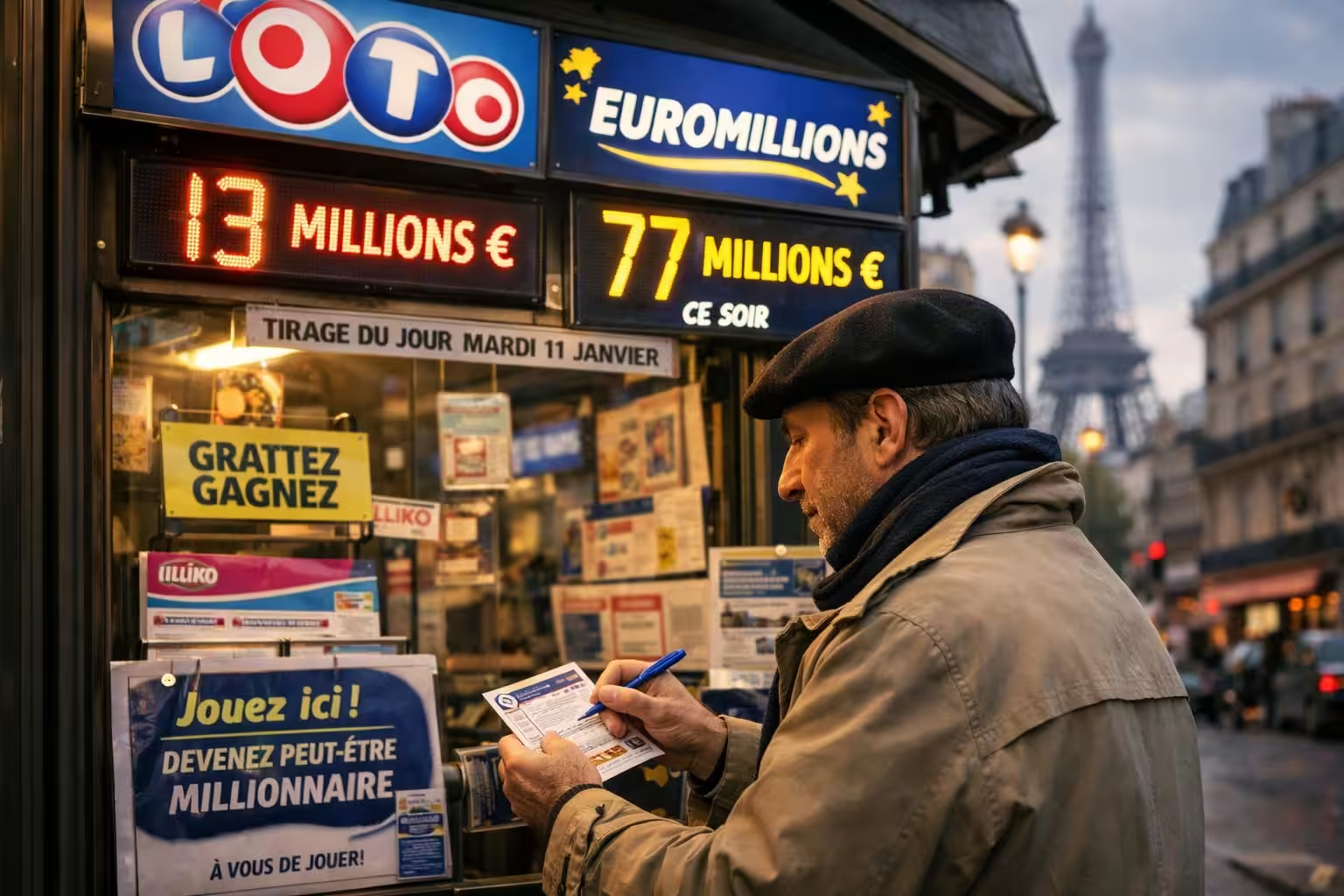
FDJ and Its Role in French Society
Every time a French player buys a Loto ticket, an EuroMillions line, or a scratch card, a significant portion of that money flows back into French society. This is not accidental — it is built into the legal framework that governs La Française des Jeux (FDJ) as France’s exclusive national lottery operator.
FDJ was originally founded in 1933 as the Loterie Nationale, with the explicit purpose of raising money to support disabled veterans of World War I. Nearly 90 years later, the social mission of the French lottery has broadened considerably — but the underlying principle remains: lottery revenues serve a public purpose.
Today, FDJ contributes to the French state treasury, funds sporting federations, supports cultural institutions, finances public health campaigns, and maintains its historic commitment to veteran welfare. Understanding how these funds flow helps players appreciate that playing the French lottery is, in part, a contribution to French society.
Where Does FDJ’s Revenue Go?
For every €100 spent on FDJ lottery products, the breakdown is approximately as follows — based on FDJ’s publicly reported financial statements.
| Destination | Approx. Share | Details |
|---|---|---|
| Prize Payments | ~60% | Paid back to players as winnings across all prize tiers |
| State Levy & Taxes | ~20% | Prélèvements obligatoires — mandatory levy to the French state treasury |
| FDJ Operations | ~12% | Retail network, staff, technology, marketing, and administration |
| Retailers & Distributors | ~6% | Commission paid to FDJ’s 30,000+ retail points of sale across France |
| Social & Public Contributions | ~2% | Sports federations, cultural causes, veteran support, public health |
FDJ and French Sport
Sport is the single largest area of FDJ’s direct social contribution beyond its state levy obligations.
Under French law, a defined portion of FDJ’s revenue is earmarked for French sport. This funding flows through the Centre National pour le Développement du Sport (CNDS) — now restructured as the Agence Nationale du Sport (ANS) — which distributes grants to sports federations, local clubs, and infrastructure projects across France.
FDJ also acts as a direct sponsor of elite French sport, supporting the national cycling team and the Team FDJ cycling team — one of France’s most prominent professional cycling teams on the UCI WorldTour circuit.
Additionally, FDJ is one of the principal financial supporters of the French Olympic and Paralympic programmes, having contributed to preparation budgets for multiple Olympic Games.
Veterans, Public Health & Social Causes
FDJ’s original purpose — dating back to its founding in 1933 — was to provide financial support for disabled veterans of World War I. This commitment remains embedded in French lottery law. A portion of FDJ’s revenue continues to flow to the Office National des Combattants et Victimes de Guerre (ONaCVG), which supports French war veterans and their families.
Beyond veteran welfare, FDJ contributes to broader public health and social initiatives. This includes funding for responsible gambling programmes, public education campaigns about the risks of problem gambling, and contributions to the national gambling helpline Joueurs Info Service.
FDJ is also legally required to fund the operations of the Autorité Nationale des Jeux (ANJ) — the independent regulator that oversees all gambling in France. This self-funded regulatory model ensures oversight without additional cost to the French state.
How Transparent Is FDJ?
Since its 2019 IPO on Euronext Paris, FDJ has been subject to the full financial disclosure requirements of a publicly listed company. This means FDJ publishes annual reports, half-year financial statements, and detailed breakdowns of revenue distribution — all publicly available to shareholders and the general public.
FDJ’s annual reports include specific sections on its social contributions, sports sponsorship, responsible gambling initiatives, and environmental commitments. These reports are published on FDJ’s investor relations website and filed with the AMF (Autorité des Marchés Financiers), France’s financial markets regulator.